

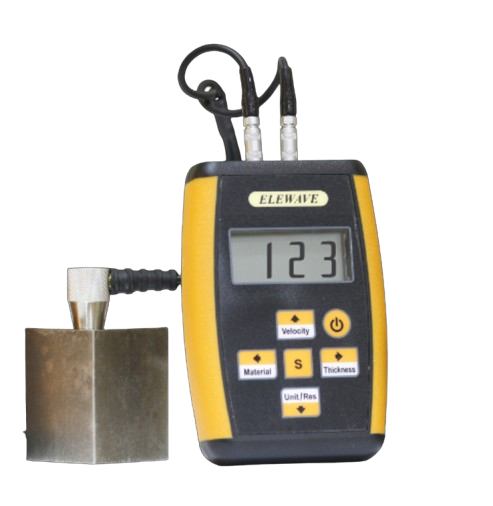
ULTRASONIC THICKNESS GAUGE
Elecoat is premier Indian Manufacturer of Ultrasonic Thickness Gauge

ULTRASONIC BASICS PRINCIPLES AND APPLICATIONS
Sound is a mechanical wave which travels with specific velocities depending on medium of propagation, which may be Solid, Liquid or Gases. Sound waves having very high frequencies reflect from boundaries of materials and produces distinct echo patterns. For transmitting sound waves and receiving echoes, ultrasonic sensors normally called as transceivers or transducers are used. The commonly used transducers are Contact, Angle beam, Delay line, Immersion and Dual element transducers. Propagation of sound waves through solid material are determined by Ultrasonic Transducers.
When an electric pulse of voltage is applied to ultrasonic Transducer it vibrates across a specific spectrum of frequencies and generate burst of sound waves. These sound waves get reflected back in form of echo and an electric pulse is generated. Based on these pulses, thickness can be calculated. The amount of time taken for sound to travel through medium and amplitude of received signal are the values to be measured,
FORMULA
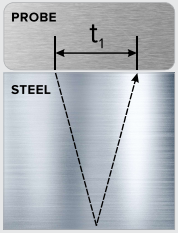
The most common methods of Ultrasonic measurements utilizes either longitudinal waves or shear waves. The Longitudinal wave is a compression wave in which the particle motion is in the same direction of the propagation wave. The shear wave is a wave motion in which the particle is perpendicular to the direction of propagation. Ultrasonic measurement is a Non Destructive type technique. i.e. it introduces high frequency sound waves into the test object without altering or damaging it in any way.
Ultrasonic detection is most commonly used in Industrial Applications to detect hidden tracks, discontinuities, Thickness Measurement in metals, composites, plastics, and ceramics.
FEATURES
-
1. Gauge Versatility
Instrument is Handheld, light weighted, having big clear visual display along with Sound audible buzzer on easy to carry ABS case with attractive tactile Membrane keypad. -
2. Principle Technique
Non-Destructive: Ultrasonic thickness gauges utilize non-destructive testing methods, allowing measurement of thickness without damaging the substrate. This saves both time and resources, making them ideal for various industries. -
3. Probe Sensor
Well-balanced Probe Sensor With advanced sensor technology and precise calibration offer exceptional reading accuracy, speed and repeatability.
-
4. Wide Calibration options
• Velocity Calibration Mode.
• Thickness Calibration Mode.
• Material Calibration Mode.
• Inbuilt Material Standard Velocities like Mild Steel, Stainless Steel, Aluminium, Copper, Brass, Glass -
5. Inch/MM Converter
To convert measured units either in MM or Inch. -
6. Resolution Converter
To select resolution either in 0.1 or 0.01.
Technical Specifications
| ELECOAT | Ultrasonic Thickness Gauge |
|---|---|
| Model | Available Ranges |
| UTG | 1.2-300 mm in steel |
| D-Meter | 1.2-20 mm in steel |
| Display Information | 31½ Digit Clear LCD Display |
| Accuracy | ±0.5mm or ± 1% whichever is more |
| Resolution | 0.01<100mm, 0.1>100mm |
| Battery Type | 9V (6f22) Alkaline battery |
| Battery Life | 40 hours |
| Gauge Dimensions (L x W x H) | 117 x 85 x 24 mm |
| Gauge Weight | 300 g |
| Operating Temperature | 0°C to 50°C |
| Packing List | Elecoat Gauge, Standard Thickness Base, Ultrasonic Couplant, 1x9V Alkaline battery, Instruction Manual, Handy Wooden Carry Case |
| Standard | ASTME 797, EN 14127, EN 15317 |
LAWS ERRORS AND LIMITATIONS OF ULTRASONICS
-
Couplant
Couplant is used for transmitting ultrasonic waves between probe and Test Piece.
Incorrect selection of Couplant may cause error.
Couplant should be in adequate quantity and must adhere to test surface
For Smooth surface low viscous Couplant like machine oil must be used and for rough surfaces high
viscous Couplant like gel, grease etc must be used. -
Laminated, Compound, Porous Material
Ultrasonic waves do not penetrate properly through laminated, compounded or porous material, so accurate
measurement of their test piece is not possible. -
Super Thin Materials
While measuring super thin materials (Less than 2-3 mm), the displayed reading might be as big as twice the
actual thickness this type of transducer limitation is known as" Dual Deflection". Another similar limitation is
known as Pulse/Cycle jumping which also shows reading bigger than actual. -
Curved Surfaces
For Curved surface (in steels) radius of test piece must be above 10mm and wall thickness must be above
3mm. -
Surface Roughness, Rust and Eroded Pits
Surface Roughness, Rust and Eroded pits may cause haywire readings. Under certain cases there might even
be no readings. -
Non Parallel Surface
In order to obtain satisfactory results the other side of test piece must be parallel or coaxial with test surface.
Else there will be erratic readings. -
Surface oxidation in Metals
Few Metals like Aluminium has Surface Oxidation tendency, due to which reading error may occur.
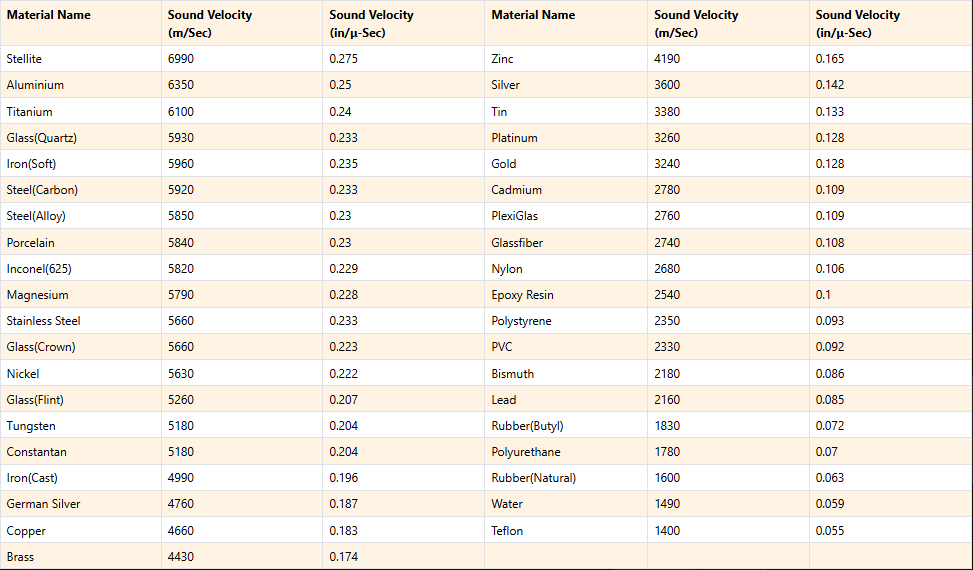
Sound Velocity Chart of Common Materials
| Material Name | Sound Velocity (m/Sec) |
Sound Velocity (in/μ-Sec) |
Material Name | Sound Velocity (m/Sec) |
Sound Velocity (in/μ-Sec) |
|---|---|---|---|---|---|
| Stellite | 6990 | 0.275 | Zinc | 4190 | 0.165 |
| Aluminium | 6350 | 0.25 | Silver | 3600 | 0.142 |
| Titanium | 6100 | 0.24 | Tin | 3380 | 0.133 |
| Glass(Quartz) | 5930 | 0.233 | Platinum | 3260 | 0.128 |
| Iron(Soft) | 5960 | 0.235 | Gold | 3240 | 0.128 |
| Steel(Carbon) | 5920 | 0.233 | Cadmium | 2780 | 0.109 |
| Steel(Alloy) | 5850 | 0.23 | PlexiGlas | 2760 | 0.109 |
| Porcelain | 5840 | 0.23 | Glassfiber | 2740 | 0.108 |
| Inconel(625) | 5820 | 0.229 | Nylon | 2680 | 0.106 |
| Magnesium | 5790 | 0.228 | Epoxy Resin | 2540 | 0.1 |
| Stainless Steel | 5660 | 0.233 | Polystyrene | 2350 | 0.093 |
| Glass(Crown) | 5660 | 0.223 | PVC | 2330 | 0.092 |
| Nickel | 5630 | 0.222 | Bismuth | 2180 | 0.086 |
| Glass(Flint) | 5260 | 0.207 | Lead | 2160 | 0.085 |
| Tungsten | 5180 | 0.204 | Rubber(Butyl) | 1830 | 0.072 |
| Constantan | 5180 | 0.204 | Polyurethane | 1780 | 0.07 |
| Iron(Cast) | 4990 | 0.196 | Rubber(Natural) | 1600 | 0.063 |
| German Silver | 4760 | 0.187 | Water | 1490 | 0.059 |
| Copper | 4660 | 0.183 | Teflon | 1400 | 0.055 |
| Brass | 4430 | 0.174 |
Distinctive Competence
- Instrument Designed by us are Indigenously Developed and Manufactured in India.
- Instruments are manufactured Using Quality Precision Components which makes them Accurate and Reliable.
- Instrument are Comparable to Finest similar Competitor in the World and works as Direct Import Substitute in India
- Instrument are serviced for at least 10 Yrs after Domestic and International sales.
- Instruments supplied are of Industrial ASTM/ISO Standards aligning them with Companies Standards
- Instrument Innovation is Our Passion and there are VALUABLE CUSTOMERS who makes IT POSSIBLE